
The Silence and Hypocrisy of the Indian Left on Punjab
When former Punjab police chief KPS Gill passed away, a veteran communist leader , Sitaram Yechury, attended his funeral and paid tribute to him, describing him as a “nek banda” (a good person). Many may argue that such a tribute was shaped by the history of violence during Punjab’s militancy years, particularly the killings of communist leaders by Khalistani militants. However, this argument ignores a crucial distinction: while those accused of targeting communists were largely eliminated through state operations, the officials accused of carrying out fake encounters, illegal detentions, and enforced disappearances of Punjabi Sikh youth were often rewarded, promoted, and celebrated by the state.
KPS Gill remains one of the most prominent examples of this contradiction. He was hailed as the architect of the counterinsurgency strategy in Punjab, awarded the Padma Shri, and died at the age of 82. Yet the allegations surrounding his role in human rights abuses, including accusations of extrajudicial killings by rights groups and activists, remain part of Punjab’s unresolved history. The disappearance and murder of human rights activist Jaswant Singh Khalra, whose investigations exposed patterns of illegal cremations and alleged state excesses, remains one of the darkest chapters of that period.
The controversy surrounding the film Satluj (formerly Panjab 95) has once again brought these unresolved questions into public debate. The film, based on the life and work of Jaswant Singh Khalra, has received support from several journalists, filmmakers, and public figures who criticised its removal from the streaming platform Zee5.
Journalist Rana Ayyub wrote a powerful critique of the decision, arguing that a democracy confident in its institutions should not fear a film about a man whose murder has already been adjudicated by the courts. Similarly, film critic Sucharita Tyagi spoke against the ban and interviewed director Honey Trehan about the making of the film. The Telegraph described the controversy as a reminder that “democracy dies when accountability disappears.”
The response has also exposed political contradictions. Leaders from Punjab, including Finance Minister Harpal Cheema and Speaker Kultar Sandhwan, criticised the ban, arguing that both the Congress and BJP have avoided confronting one of the darkest periods in Punjab’s history. Congress leaders such as Pargat Singh and Sukhpal Khaira have also spoken in favour of allowing the film to be released.
However, a section of the Indian Left and liberal intelligentsia has remained conspicuously silent. More significantly, Hartosh Singh Bal, editor of The Caravan, criticised the film and described it as “propaganda,” placing it alongside films such as The Kashmir Files and The Kerala Story.
This comparison is deeply contested. Unlike films that have been criticised for portraying entire communities through a lens of hatred and suspicion, Satluj does not present a simplistic narrative of good versus evil. The film does not argue that the entire Indian state or police institution was responsible for atrocities. Rather, it focuses on individuals within institutions who allegedly abused their power. Its criticism is directed towards impunity, not towards an entire community or system.
The Congress, meanwhile, has adopted a cautious position. Punjab Congress president Amarinder Singh Raja Warring stated that he had not watched the film and would comment only after viewing it. Former Punjab Chief Minister Charanjit Singh Channi said that if the film was based on historical truth, it should not be banned.
The hesitation within the Congress is understandable politically. The events depicted in Satluj belong to a period when Congress governments were in power in Punjab. For many party leaders, the issue remains politically sensitive because it raises uncomfortable questions about governance, accountability, and the methods used during counterinsurgency.
The BJP too found itself responding after allegations emerged that the Centre had influenced the film’s removal. Union Minister of State Ravneet Singh Bittu rejected those allegations, stating that decisions regarding content removal rested with the streaming platform and not the government.
Yet the controversy raises a larger question: why does the image of KPS Gill continue to receive such protection within political discourse, while the victims of that period remain largely forgotten?
Gill’s supporters have long portrayed him as the “supercop” who ended militancy in Punjab. His critics, however, argue that the methods adopted during his tenure came at a devastating human cost. Human rights organisations, activists, and families of disappeared persons have repeatedly raised allegations of fake encounters and illegal cremations during that period. Gill was also accused of sexual harassment by IAS officer Rupan Deol Bajaj, a case that remains part of public discussion around his legacy.
The irony becomes sharper when one considers the criticism Hartosh Bal himself has previously made of selective accountability. In a 2016 article, he criticised sections of the liberal elite for allegedly minimising the crimes of the Congress during the 1984 anti-Sikh violence, arguing that proximity to political power often shapes public memory.
The question then arises: does the same standard apply when discussing Punjab’s counterinsurgency years? Does personal proximity influence how certain figures are remembered and defended? Can accountability be demanded from political opponents while being avoided when it concerns one’s own ideological or personal circles?
This contradiction is particularly visible in how sections of the Indian liberal and left ecosystem have approached Kashmir and Punjab differently. There has been considerable sympathy and attention towards human rights violations in Kashmir, as there should be. However, Punjab’s experience of state violence has often received far less recognition within the same circles.
This selective empathy is especially troubling because Jaswant Singh Khalra himself was not merely a voice for Sikh grievances. He was a committed advocate of human rights and secularism. In his speeches, he criticised Hindutva politics, opposed the demolition of the Babri Masjid, and warned about the dangers posed by communal politics. His worldview was far broader than a narrow identity-based framework. Yet when discussing Khalra today, some voices reduce him only to the context of militancy and ignore his larger commitment to justice and constitutional values.
Perhaps ironically, the controversy over Satluj has ensured that more people have learned about Jaswant Singh Khalra than they otherwise would have. The attempt to suppress the film has created the very conversation that many may have wanted to avoid. Several unexpected voices have spoken in support of the film, including Ambedkarite content creators and independent platforms that have highlighted Khalra’s work.
As cinema, Satluj is compelling. Its narrative is carefully constructed, its pacing remains controlled despite its long runtime, and much of the credit belongs to editor Sreekar Prasad, whose work ensures that the film never loses momentum. But the importance of Satluj lies beyond its cinematic qualities. It is a film about memory, accountability, and the consequences of institutional silence.
Unlike Maachis, which explores how ordinary people become drawn into militancy, Satluj is the story of an ordinary citizen who refuses to look away. Khalra’s investigation did not begin with dramatic revelations. It began with government records, crematorium registers, hospital documents, and missing-person reports. Through painstaking documentation, he reconstructed the stories of thousands who disappeared without answers.
The power of Khalra’s work was that he transformed forgotten paperwork into evidence of human suffering. He challenged a system that believed anonymity could erase injustice.
One of the film’s most powerful moments depicts Khalra addressing an audience in Canada:
“The country that calls itself the world’s largest democracy has made a mockery of justice.”
He speaks about unidentified bodies, missing records, and families denied even death certificates. These words capture the central question of the film: what happens when institutions designed to protect citizens become unwilling to answer for their actions?
The controversy also raises another question: why would any government fear a film about events that occurred decades ago, particularly when those events took place during a period dominated by Congress governments?
One possible explanation lies in the continuing political symbolism of Punjab’s counterinsurgency era. For sections of the political right, KPS Gill remains a symbol of state strength and victory over militancy. Any criticism of that legacy is often portrayed as an attack on national security. This has created a framework where voices demanding accountability are sometimes labelled as “Khalistani,” “anti-national,” or sympathetic to separatism rather than engaged on the substance of their arguments.
But democracies cannot heal through denial. They heal through acknowledgement, accountability, and empathy.
The larger question is why successive governments have failed to engage seriously with the unresolved pain of Punjab. Families who lost loved ones have spent decades seeking answers. Survivors of violence from different sides continue to carry trauma. Yet instead of confronting this history, political establishments have often chosen silence.
Whether one agrees with every interpretation presented in Satluj or not, the film raises questions that any democracy must confront: How much accountability exists when powerful institutions commit wrongdoing? What happens when families are denied closure for decades? Why does seeking justice become controversial when it challenges official narratives?
These questions are not limited to Punjab of the 1990s. They remain relevant wherever institutions escape scrutiny and where victims struggle to make their voices heard.
The words of Jaswant Singh Khalra continue to resonate:
“Main hanere nu challenge karda haan” — “I challenge the darkness.”
The officers and officials accused of crimes during that period will eventually disappear into history. But Khalra’s legacy continues because his struggle was never only about one moment, one community, or one conflict. It was about the belief that truth cannot remain buried forever.
Through films like Satluj, through journalism, and through those who continue to document forgotten histories, that challenge to darkness continues.
And finally, here is a newspaper excerpt that talks about a veteran Indian communist leader Harkishan Surjeet shedding tears for Gill.
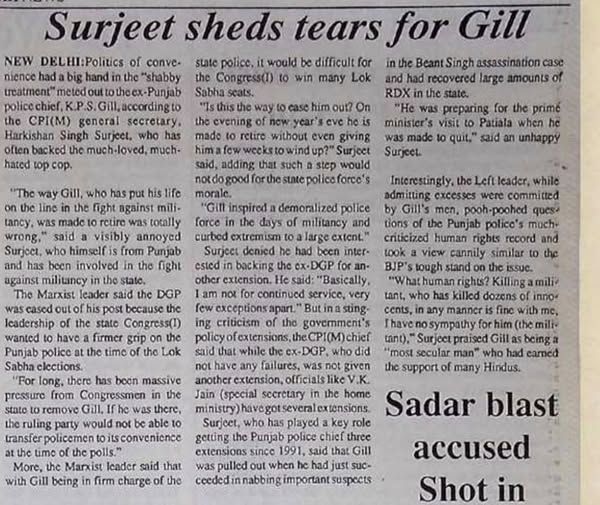
Surjeet praised Gill as being a “most secular man” who had earned the support of many Hindus.
He said “What human rights? Killing a militant, who has killed dozens of innocents, in any manner is fine with me, I have no sympathy for him (the militant),”