Sikh - Shia Parallels : Sacred Chivalry, Divine Leadership
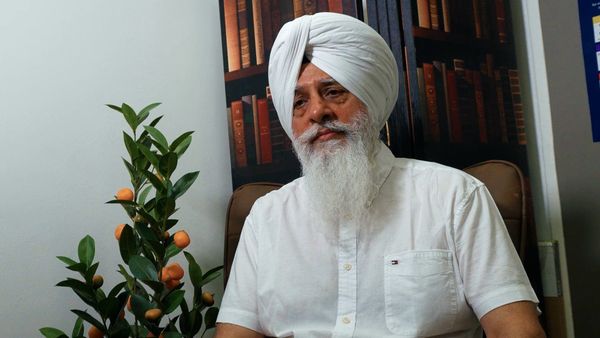
Peer Buddhu Shah was a Muslim divine known as Badr ud Din. He admired and supported Guru Gobind Singh. He visited the Guru often and at one time introduced 500 Shi‘a Muslim Pathan soldiers, expelled by Aurangzeb, who joined the Guru's forces.
Studying Sikh-Shi‘a relations in Iran provides a unique perspective on how these two different spiritual traditions have coexisted and supported each other. Sikhs make up a tiny demographic in the Islamic Republic, mainly involved in business and trade. Their presence highlights Iran’s historical role as a crossroads of cultures. Despite their small size, the history of their interactions with local Shi‘a communities is mostly overlooked in mainstream discussions. By exploring these connections, we can reveal a rich history of alliances and shared values that go beyond religious differences.
The Sikh community in Iran dates back to the early 1900s when families began settling in the southeastern city of Zahedan in Sistan and Baluchestan Province, eventually spreading to the capital, Tehran. Today, the community remains small but stable, with around 15 to 20 families in Zahedan and about 100 families in Tehran. Their integration is not only economic but also civic. Iran requires all adult men to serve in the military, so many Sikh men have served in the Iranian army alongside Shi‘a soldiers. This has strengthened their status as dedicated members of Iranian society.
The relationship between Sikhs and local communities is built on mutual respect, often based on the Sikhs' reputation for integrity and business ethics. A well-known historical story illustrates this cultural blend and the naming of Zahedan. When Reza Shah visited the area, he met the local Sikh population. Impressed by their turbans and bearded appearance, he mistakenly thought they were Sufi ascetics or "pious ones." As a result, he renamed the town Zahedan, which means "The Pious Ones" in Persian. This name remains a lasting mark of the Sikh presence in Iran.
The roots of this solidarity run deep, anchored in the historical figure of Peer Buddhu Shah (1647–1704). Buddhu Shah was a respected Shi‘a Muslim divine and a strong ally of Guru Gobind Singh, the tenth Sikh Guru. He made a notable act of solidarity by introducing 500 Shi‘a Pathan warriors, unjustly ousted from the Mughal army by Aurangzeb, to the Guru's forces. This alliance was not just political; it was a shared stand against tyranny. Buddhu Shah's commitment was so strong that he and his followers fought alongside the Sikhs in the Battle of Bhangani in 1688. He even sacrificed his own sons for the Guru’s cause, a gesture that holds great significance in Shi‘a culture, particularly regarding martyrdom (Shahadat).
Ultimately, these historical ties—from Peer Buddhu Shah's sacrifice in the 17th century to the modern Sikh presence in Iran—show how shared values of spiritual dedication and warrior honor have linked these two communities across centuries. This history reflects deep Sikh-Shi‘a solidarity against oppression, suggesting that despite their theological differences, the two groups share a common heritage of loyalty, honor, and the quest for justice.

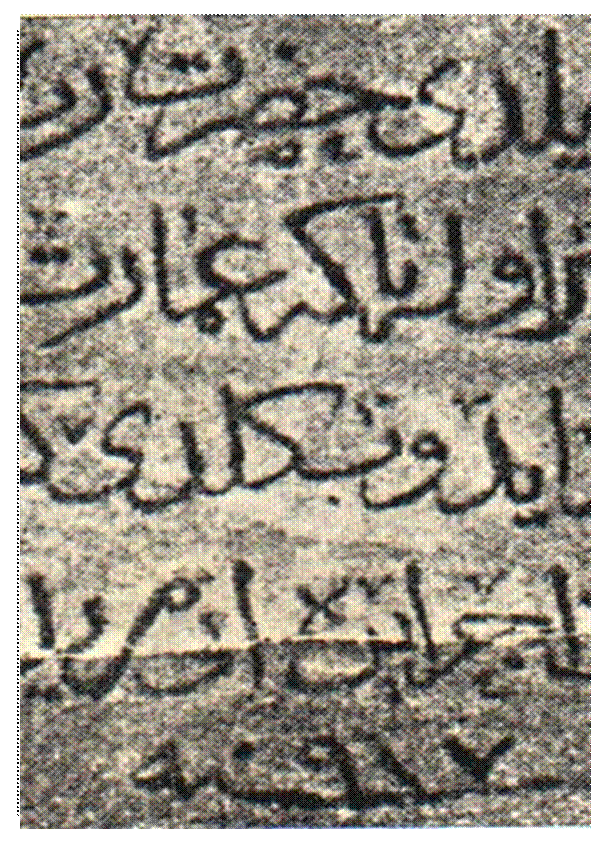
At the Sikh shrine of Takht Sri Keshgarh Sahib in Anandpur Sahib, several weapons related to the Sikh Gurus and notable saints are kept. One of these artifacts is a broad, straight blade with a crescent moon and an inscription known as the jibrailiyya:
"La fata illa 'Ali, la saif illa Dhulfiqar" – 'There is no hero of God except ‘Ali, and there is no sword of God except Dhulfiqar.'
Tradition states that this sword may have belonged to Imam ‘Ali or could be one of his legendary weapons. Its presence in such an important Sikh shrine allows for exploration of the historical and theological connections between Sikhism and Shi‘a Islam. (Luis, 2006)
This artefact raises significant questions about the links between Sikh and Shi’a traditions, especially in a place like Iran, where Shi’a Islam is very dominant. While it remains unclear whether this particular sword belonged to Imam Ali himself, its presence in a respected Sikh shrine like Keshgarh Sahib encourages us to look into the relationship between Sikh and Shi’a beliefs.
Shia Sikh Connections in Early Sikhism
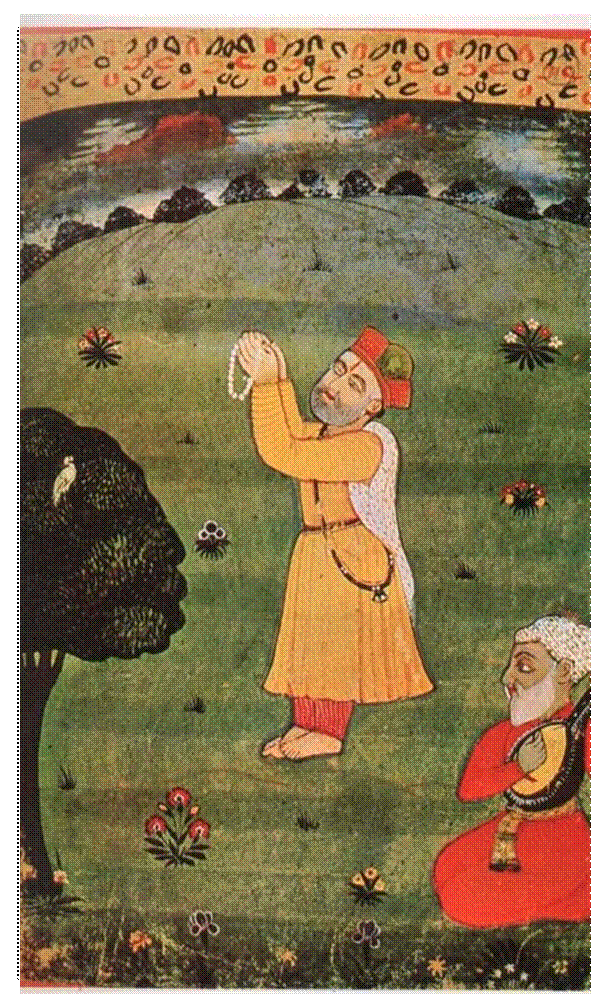
The spiritual connection between the Sikh and Shi‘a traditions runs deep in the earliest texts and mystical practices of Sikhism. In the B40 Janamsakhi literature, hymns show a strong bond between Guru Nanak and Shi‘a Islam. They document moments when the Guru offered spiritual advice to Muslim followers. This guidance included instructions to meditate on the Divine Name while honoring the sacred status of Lady Fatimah Zahra, Imam Hassan, and Imam Hussain. This practice closely mirrors Shi‘a meditation traditions.
Moreover, Guru Nanak’s focus on the heart as the main mystical center sets his teachings apart from many Indic traditions that emphasize the ajna or sahasrara chakras. This change reflects the mystical beliefs of both Shi‘ism and Sufism, where the heart is seen as the spiritual home of the "Infallibles" (Muhammad, Ali, Fatima, Hassan, and Hussain). These mentions of the Holy Five residing within the heart create a direct link between Sikh meditation methods and the inner devotional practices of the Shi‘a tradition.
Shared Symbolism and Spiritual Affinity
The visual and theological story of Guru Nanak’s ministry highlights a deep blending of Indic and Islamic traditions, especially leaning toward Shi‘a-Sufi mysticism. Historical records in the Janamsakhis and the Varan of Bhai Gurdas describe the Guru’s clothing as a thoughtful mix. He wore the tilak and mala along with an Islamic-style blue tunic, hat, and the seli, which is a wool cord. This choice was not just about looks; it represented a spiritual connection to the devotional practices of Shi‘a and Sufi groups. This respect across cultures is reflected in South Asian Ismaili hymns called Ginans, where Guru Nanak is honored as a saint who reached enlightenment through the "true name." This suggests a shared spiritual outlook between the early Sikh community and Ismaili Shi‘a traditions.
A significant moment of theological discussion is recorded in the Bhai Mani Singh Janamsakhi. It describes a dialogue between Guru Nanak and Shi‘a pilgrims from Mashhad. When they asked him to help resolve the divide between Sunnis and Shi‘as, the Guru offered a complex merging of Islamic and Sikh ideas. He said, "Know that Muhammad and Ali are one. Muhammad exceeded in knowledge; Ali exceeded in chivalry. The light of God is both in Muhammad and Ali. It is also in the four friends and in your heart, but you have forgotten about it."
This statement directly refers to a well-known Shi‘a hadith about the Nur, or light, of the Prophet and Imam Ali, claiming they were created from the same divine light before the world began. By affirming this unity, Guru Nanak recognized a key aspect of Shi‘a identity. However, he also broadened the discussion to include "the four friends," which refers to the first four caliphs, and the individual human heart. By doing this, he shifted the focus from external disputes to a more universal understanding. He taught that the divine presence exists within everyone, even if it has been overlooked due to human ignorance.
Sikh and Shia Interactions - Guru Nanak ji and Guru Gobind Singh Ji
The historical and spiritual connections between Sikhism and Shi‘ism are clearly shown in Guru Nanak’s journey to Baghdad. When he arrived, Guru Nanak called the people to prayer, but instead of performing a traditional salat, he started a sama, which is a mystical musical gathering. With Bhai Mardana playing the rabab, the Guru sang in Persian, creating a spiritual atmosphere that crossed traditional sectarian lines. During his visit, Guru Nanak had an in-depth theological discussion about the existence of multiple universes with Shaikh Bahlol, who was a companion of Imam Musa al-Kazim. The meeting ended with Shaikh Bahlol bowing to the Guru in a show of deep respect. Today, Guru Nanak’s shrine in Baghdad is still a place of shared devotion, maintained by local Shi‘as who often place images of the Sikh Gurus next to those of the Shi‘a Imams.
As the Sikh movement progressed during the Mughal era, these spiritual ties turned into important political alliances. The Mughal court featured a rivalry between two groups: the Turani (Turkish) faction and the Irani (Iranian) faction. The Turani group, which followed Sunni Hanefi orthodoxy and was influenced by the Naqshbandi Sufi order, held a strict view against religious change. This influence played a key role in the execution of Guru Arjan and the following persecutions under Aurangzeb, who targeted Sikhs, Shi‘as, and Sufis.
On the other hand, the Irani faction, mostly made up of Shi‘as and Sufis, showed openness to Indic traditions and kept connections with Safavid Iran. A notable figure in this group was Prince Dara Shukoh, a close friend of Guru Har Rai who promoted religious unity. In his important book, Majma’ al-Bahrayn, or "The Mingling of the Two Oceans," Dara Shukoh argued that Islamic batin (inner truth) and Indic wisdom shared a common essence, even though their zahir (outer form) was different. His translation of the Upanishads into Persian, called Sirr al-Akbar, eventually influenced European thinkers like Schopenhauer. These moments highlight a legacy of Sikh-Shi‘a engagement marked by both spiritual harmony and a collective resistance against sectarian oppression.
Guru Gobind Singh ji and Shia Alliances
The historical alliance between Guru Gobind Singh and important Shi‘a figures shows a shared commitment to justice that went beyond the strict sectarian divisions of the Mughal era. One of the key figures in this story is Pir Budhu Shah, also known as Sayyid Badr ud-Din, a respected Shi‘a Sayyid from Sadhaura. He proved his loyalty to the Guru by suggesting that Guru Gobind Singh enlist 500 Pathan warriors who had lost their jobs in the Mughal service. When these mercenaries defected, Pir Budhu Shah showed his steadfast loyalty by personally joining the Guru’s forces with 700 of his followers and his four sons at the Battle of Bhangani in 1688. The cost of this alliance was significant; the Pir lost two of his sons in the battle and was executed by Mughal authorities in 1704 for his suspected apostasy and support of the Sikh cause.
This spiritual influence even reached into the Mughal military through figures like General Said Khan, who was Pir Budhu Shah’s brother-in-law. During a confrontation with Guru Gobind Singh, Said Khan reportedly experienced a deep mystical moment when facing the Guru. Moved by the spiritual presence of the tenth Guru, he laid down his weapons and completely abandoned the Mughal cause, opting for a life of spiritual exile in the hills of Kangra. This decision by a high-ranking officer underscores the ideological rifts within the Mughal state.
These individual partnerships existed in a wider, unstable geopolitical context. Emperor Aurangzeb’s domestic policies, which involved the systematic persecution of Shi‘as and the destruction of Sufi shrines, angered the Safavid Empire in Iran. Shah Abbas II of Persia famously sent diplomatic warnings to Aurangzeb, criticizing how he treated his subjects. Against this backdrop, Guru Gobind Singh’s bold letters to Aurangzeb, the Zafarnama and Fatehnama, were not mere complaints but part of a larger political struggle against the Sunni Hanefi orthodoxy of the Turani party. After Aurangzeb’s death, the Mughal court remained deeply divided along Sunni-Shi‘a lines, with the Irani faction often finding common ground with the Sikhs in their joint opposition to the Turani-led persecutions.
Sikhs and Shia Iran- The Naming of Zahedan: A Serendipitous Misunderstanding
In the early 1930s, Reza Shah Pahlavi visited the easternmost regions of Iran. He saw men in turbans with long beards, dressed in white robes. Mistaking them for 'Zahids', holy men from India, he renamed the town Dozdaab to Zahedan, which means 'city of holy men.'
A 2001 report in The Tribune mentions an entrepreneur named Sahib Singh. He set up the Hind-Iran Bank, which had broad operations in Iran and India, but was closed in the late 1950s.
The Pahlavi family liked the Sikh community, so the Sikhs were granted Iranian citizenship easily. Community members still speak of the last Shah with great admiration and respect. Before Mohammad Reza Pahlavi was overthrown in February 1979, the Sikh community in Iran counted around 5,000 people.
In Zahedan, the Sikhs built good relationships with both the Sistanis and the Baloch. At its peak, the community included about 500 people in the Iranian border town.
Zahedan became a key entry point for Sikhs into Iran. Over time, they took over the auto parts trade, moneylending, and established a strong presence in commerce. A significant Sikh community thrived there, and the first Sikh gurudwara in West Asia was built in 1921.
However, after the 1979 Islamic Revolution, the community shrank. Many members moved to Tehran or left the country. Today, only a few Sikh families remain in Zahedan, and their numbers continue to decrease.
The Divine Guide in Sikh and Shia traditions
The spiritual foundations of both the Sikh and Shi‘a traditions connect through the idea of the Divine Guide, who is more than just a teacher; he is seen as the living representation of the Divine on earth. In Shi‘a theology, this is clearly stated in the Khutbat al-Bayan, where Imam Ali proclaims himself as the sign of the Almighty and the Face of God. Imam Ja’far al-Sadiq supports this view by explaining that believers can see God through the Imam, even before Judgment Day arrives. This view establishes the Imam as the mystical pole or Qutb of the universe, the vital link that allows humanity to understand the Divine.
Sikh thought reflects this high view of the Divine Guide, identifying the Guru as the tangible form of the Divine. Guru Nanak describes the spiritual journey of the soul in the 37th Pauri of the Japji Sahib, outlining stages such as Karam Khand, the Realm of Grace where saints fully connect with the Divine, and Sach Khand, the Realm of Truth where the Divine is completely understood. The connection between the Creator and the Guru is a common theme in the Guru Granth Sahib, which makes it clear that there is no separation between God and the Guru. As Guru Arjan Dev stated, "The Guru is Govind, and Govind is the Guru," reinforcing the idea that the Guru represents the Infinite on earth.
Guru Nanak’s encounter in Mecca illustrates this theological view. When a qazi scolded him for resting with his feet toward the Kaaba, claiming it disrespected God, the Guru calmly asked that his feet be turned toward a place where God did not exist. This story highlights the Sikh belief in divine omnipresence and emphasizes the Guru's role in awakening individuals to this universal truth.
The significance of the Guide is established in the Mul Mantar, the fundamental creed of Sikhism. It defines the Divine as Ik Onkar—the One, Fearless, Unborn, and Self-Existent—and concludes with the key phrase Gurprasadi, meaning "By the Guru’s Grace." This shows that while the Divine is the ultimate truth, understanding that reality is only possible through the Guru’s involvement. In this context, both traditions share the idea that the Divine Guide is essential for spiritual awakening and serves as the link between finite human experiences and the infinite Divine.
The idea of sacred chivalry, or javanmardi, acts as a deep spiritual connection between the Sikh and Shi‘a traditions. It represents a blend of martial discipline, self-sacrifice, and complete devotion to a Divine Guide. This warrior spirituality is not just about physical strength; it embodies divine qualities through loyalty and love for those who are oppressed.
The Hidden Guide and the Purity of the Warrior
A central idea in both traditions is the lasting spiritual presence of the Divine Guide. In Shi‘a tradition, the 12th Imam, Imam Mahdi, has been hidden since 941 and is expected to return with his Khullas, or knights of purity, to bring ultimate justice. Similarly, some Sikh traditions believe that Guru Gobind Singh did not die in 1708 but transcended death, remaining spiritually present to guide the Khalsa.
The term Khalsa shares the same Arabic root, Kh-l-s (purity), as the Shi‘a Khullas. This connection highlights a shared identity as a brotherhood of pure warriors committed to martial discipline and spiritual duty. This is shown in the clothing of the Nihang Singhs, known as Khullasi Bana, which reflects the traditional imagery of Imam Mahdi’s warriors through the crescent moon and the sword.
Initiation Rites
Initiation into these warrior groups reveals deep cultural similarities. The Khalsa Amrit ceremony, started in 1699, resembles the rituals of Shi‘a Sufi and Persian chivalry orders. In these rituals, sweetened water is stirred with a dagger to symbolize a sacred oath of surrender and rebirth. Scholars like Henry Corbin note that these javanmardi rituals go back to the time of Prophet Muhammad and Imam Ali, with roots extending into older Zoroastrian traditions.
The Panj Pyare (Five Beloved Ones) in Sikhism hold a special status similar to the five sons of the Hidden Imam in Shi‘a belief. Their names represent certain spiritual virtues, reinforcing the idea that the true knight is defined by their inner state and their "exile" for divine love rather than by birth or caste. Additionally, Guru Gobind Singh’s Zafarnama often references Firdausi’s Shahnamah, linking the Sikh warrior spirit to the Persian warrior ethos. The image of the sacred king residing among seven peaks or towers appears in both the Shahnamah and the Sikh tradition of Dusht Daman, the Guru's pre-earthly form at Hemkunt Sahib.
Both traditions have historically embraced a kind of spiritual freedom that challenges strict legalism. The specific taboos of the Khalsa—such as rejecting traditional halal and haram dietary laws—marked a shift from both Islamic shari'a and Brahmanical norms. This move from a legalistic religion to one of direct divine connection is similar to the "Great Resurrection of Alamut" in 1164, when the Ismaili Imam declared the end of outward shari'a in favor of internal spiritual truth.
In this context, the sword is no longer just a weapon of war but a symbol of justice and the bravery to uphold truth against tyranny. The true warrior in both Sikh and Shi‘a traditions is a defender of what is right, whose martial courage stems from a blend of spiritual wisdom and bravery.
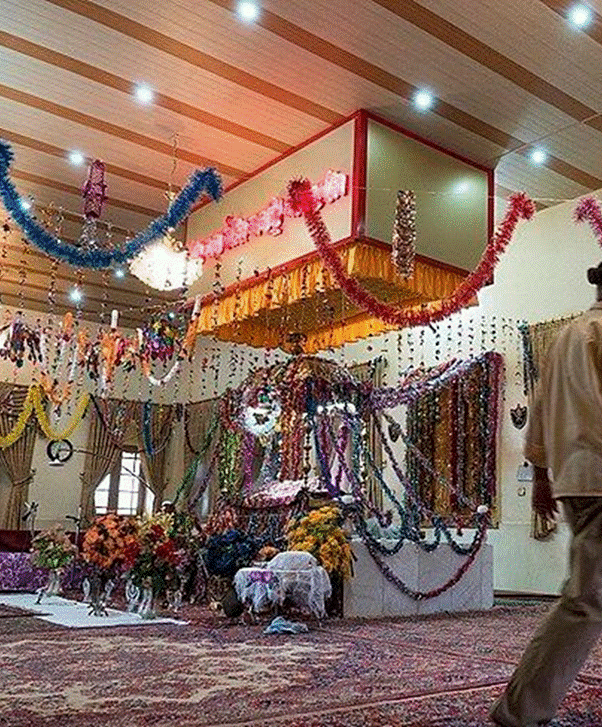
Sikhs came to Zahedan (Sistan and Baluchestan Province) in Iran in the early 1900s as businessmen, later to work in Railways and as Soldiers. There are 15-20 Sikh families in Zahedan and about 100 in capital Tehran. Military service is compulsory for all adult men (for 18 -24 months) hence more than half of all Sikhs have been in the Iranian Army.