Online Propaganda and Disinformation Blames Punjab Farmers for Delhi Pollution
Punjab, a state in northwestern India bordered by Haryana, Himachal Pradesh, and Rajasthan, has found itself at the centre of growing hostility fueled by the Hindutva right wing. This animosity stems largely from Punjab’s resistance to the BJP-RSS’s communal agenda and the fact that Sikhs, who form the state’s majority, are a micro-minority in India. The hate campaign, which intensified during the farmers’ protest when Prime Minister Modi was forced to repeal the farm laws, has once again resurfaced, this time over the issue of stubble burning and the resulting pollution in Delhi.
Just months ago, however, Punjab was reeling from one of the worst floods in centuries, a disaster that destroyed nearly five lakh acres of crops. The floods, caused largely by the negligence of the BBMB (Bhakra Beas Management Board), which failed to predict and manage water releases, left the state’s farmers devastated. Yet instead of receiving empathy or support for its losses, Punjab is now being vilified for Delhi’s toxic air. A state still recovering from environmental mismanagement and natural calamity is once again being scapegoated, this time to divert attention from the Centre’s own policy failures and urban misgovernance.
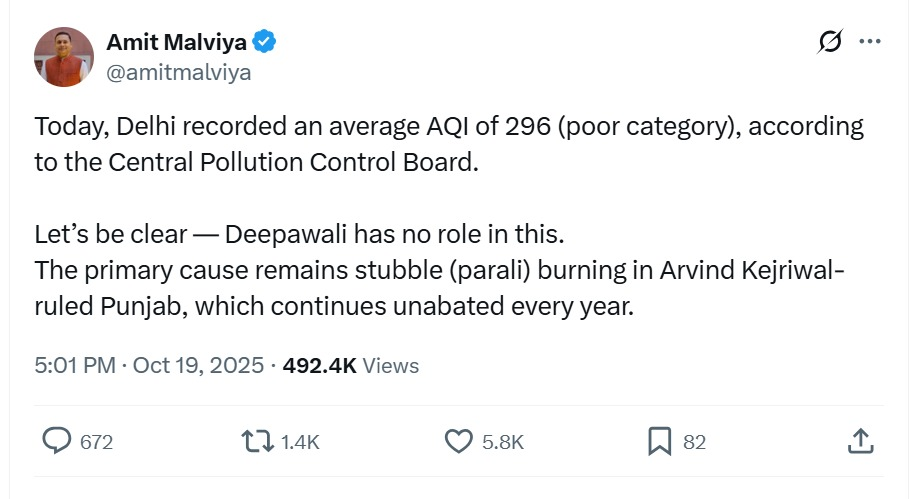
A tweet shared by BJP IT cell head Amit Malviya blamed Punjab’s stubble burning for Delhi’s pollution, conveniently leaving out Haryana, which is actually closer to Delhi than Punjab. Although data shows that Haryana, Uttar Pradesh, and industrial pollution are the major causes of Delhi’s poor air quality. The fact that Delhi became the most polluted city in the world immediately after Diwali night, and that the pollution peaked around midnight, directly connects the dots. Firecrackers are the most plausible and immediate cause. Yet the propaganda machinery continues to single out Punjab and, by extension, Sikhs.
Meanwhile, Manjinder Singh Sirsa, Delhi Environment Minister held a press conference on Tuesday, showing videos from Tarn Taran (a district near the Pakistan border) and Bathinda, claiming that farmers were being forced to burn stubble to pollute Delhi. However, this argument doesn’t hold ground, as both regions are far from Delhi, and their air masses rarely travel directly toward the capital. It seems more like an attempt to divert attention from the real and immediate cause : Firecrackers.
For the past few years, several influencers and actors have urged people to stop bursting crackers, only to be labelled anti-Hindu by right-wing groups. In response, various Hindutva influencers and IT cell accounts encouraged their followers to burst even more crackers, calling environmental awareness “woke propaganda.” This year, YouTuber Dhruv Rathee released a video asking people to avoid crackers, prompting many to defiantly post that they would increase their spending on fireworks. One user even wrote that they had doubled their budget from ₹5,000 to ₹10,000 after watching his video, and many others shared similar posts. The morning after Diwali, when Delhi’s pollution reached severe levels and entered the red zone, the blame once again shifted to Punjab’s farmers and stubble burning.
However, recent data tells a very different story. According to an analysis by Newslaundry, based on two weeks of data (October 5–19, 2025) compiled by the Indian Institute of Tropical Meteorology (IITM), Pune, under the Ministry of Earth Sciences, Haryana alone accounts for an average of 24.7% of Delhi’s PM2.5 load. It is followed by Uttar Pradesh at 8.4% and Rajasthan at 1.39%. Eleven cities in Haryana, including Sonipat and Jhajjar, have emerged as major contributors, primarily due to industrial activity and thermal power plants. Experts note that wind patterns carry pollutants from Haryana towards Delhi, worsening the city’s smog.
In contrast, stubble burning mostly in Punjab contributed only 1.21% during the same period, rising slightly to 4.6% by October 19 as the harvest season progressed. The IITM’s Decision Support System (DSS) and Air Quality Early Warning System (AQEWS) reveal that local sources such as transport (18.3%) and industry (3.8%) remain the dominant contributors to Delhi’s pollution. Yet, Punjab continues to face disproportionate criticism, while systemic industrial and vehicular pollution across NCR states receives far less scrutiny.
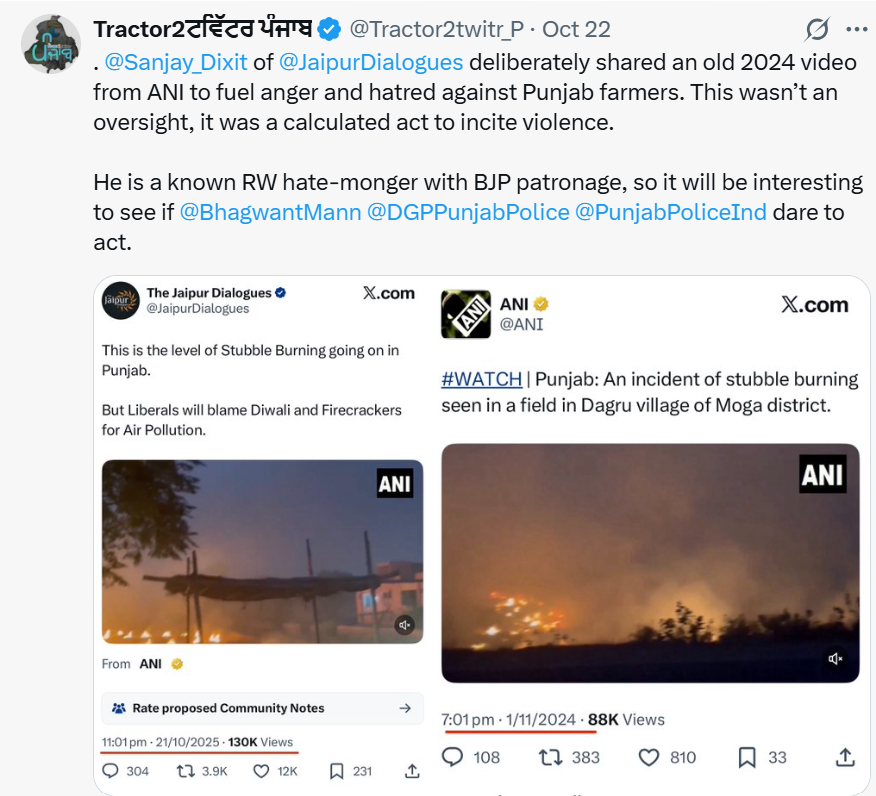
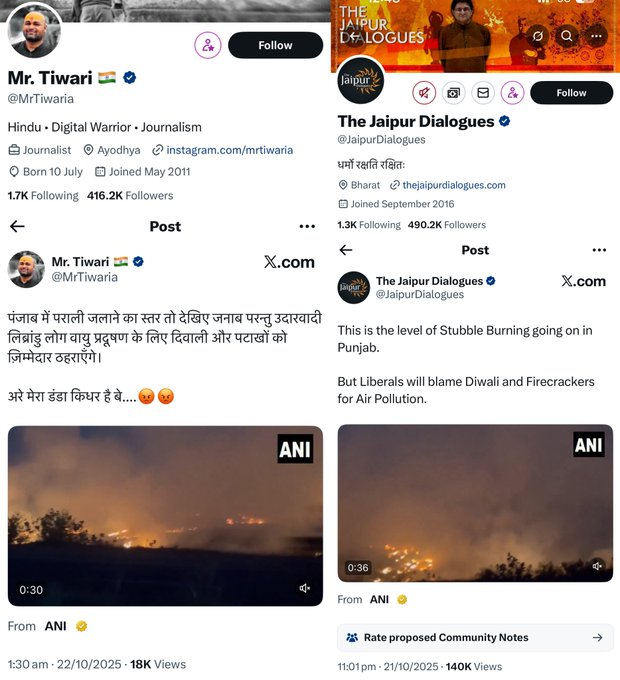
The Jaipur Dialogues, a right-wing X (formerly Twitter) page with over 490,000 followers run by Sanjay Dixit, recently shared an old video from 2024 showing stubble burning in Punjab to spread disinformation and fuel anger against the state. However, their propaganda was exposed by Tractor2Twitter.
Despite over 200 farm fires being recorded daily in neighbouring states, stubble burning has contributed only around 1% to Delhi’s PM2.5 levels on most days this season. The highest share so far was merely 2.6% on October 17. In comparison, during the same period last year (October 22–28), paddy residue burning contributed between 8% and 15% daily, according to the Decision Support System (DSS).
Delhi continues to choke after toxic Diwali celebrations, as firecrackers releasing sulphur oxides, nitrogen oxides, and heavy metals have severely worsened air quality. Although a complete ban on firecrackers was imposed in 2020, the Supreme Court this year allowed the use of “green” firecrackers within limited hours. However, enforcement remained weak, with widespread violations and the continued use of banned, high-polluting firecrackers.
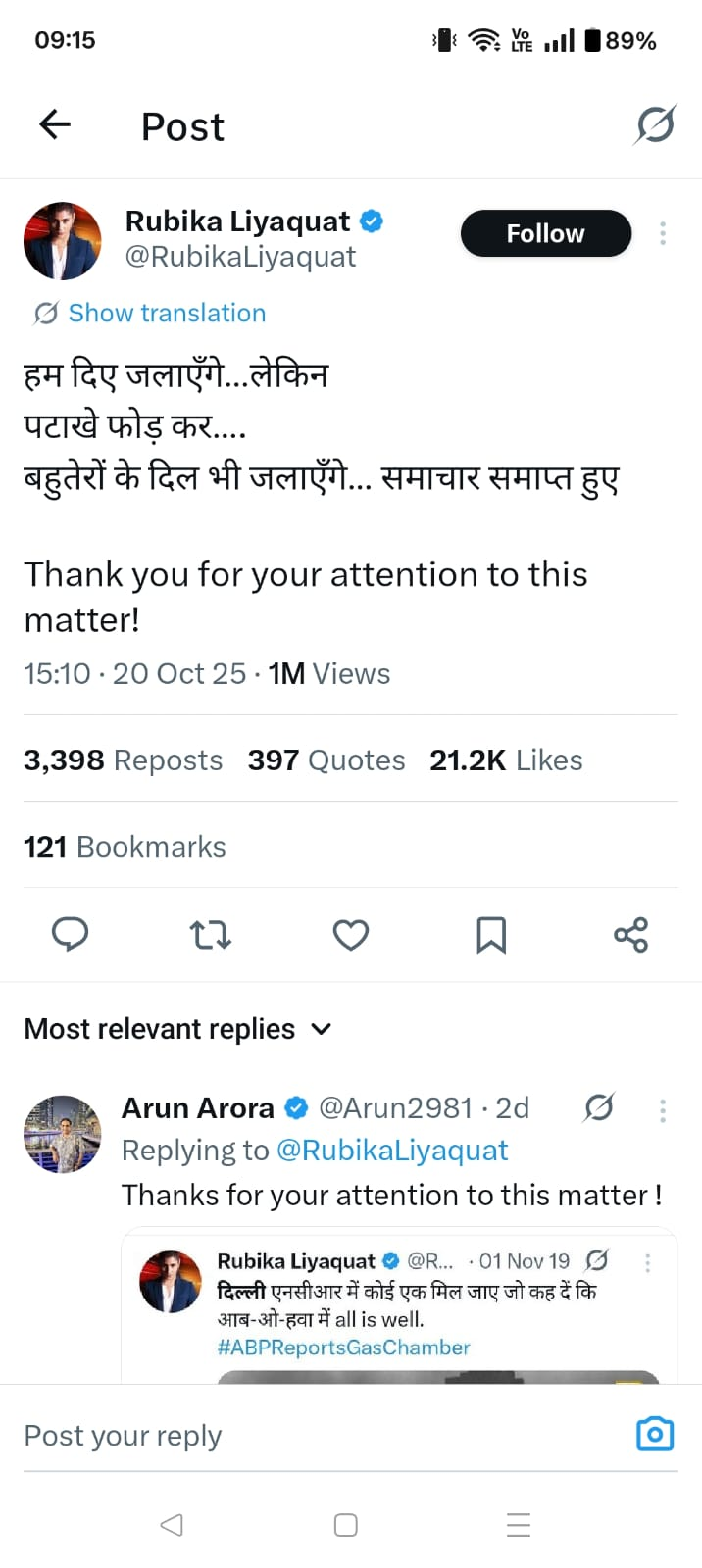
The situation was further aggravated by propaganda from certain news anchors and journalists who encouraged people to defy the ban. On X, journalist Rubika Liyaqat wrote, “We will light candles but after bursting crackers, and we will give heartburn to many. Thank you for your attention to this matter.” Such public statements only fueled defiance and undermined efforts to reduce pollution in the capital.
Stubble burning usually contributes less than 5% to Delhi-NCR’s air pollution, and this year it has remained around just 1%. Yet, farmers in Punjab continue to face disproportionate blame, while the main culprits such as industry, transport, construction dust, and power plants remain largely unaddressed.
Studies by TERI and SAFAR show that industry and transport together account for nearly 60% of PM2.5 emissions, while road dust, construction activity, and thermal power plants add significantly more. The Centre for Research on Energy and Clean Air (CREA) has found that NCR’s thermal power plants emit up to sixteen times more pollution than stubble burning or vehicles. Despite such findings, the Environment Ministry has repeatedly extended deadlines for implementing pollution control measures, allowing major polluters to continue unchecked.
A report by TOI tells when the air quality stations of Delhi peaked with PM 2.5 and PM 10 during diwali night, the stations stopped showing the data for 5 hours and they were back in the morning showing downwards trends, Another video is getting viral on internet where the water tanks were spraying mist at anand vihar AQi station to manipulate the AQI reading, From the start, the Delhi government has sought to dodge accountability by shifting the blame onto Punjab’s farmers, suppressing or manipulating air-quality readings, and ultimately obscuring the fact that its own supporters repeatedly violated cracker curbs. The speech by Delhi CM, Rekha Gupta, captures this deflection: “We have all seen the data. If we compare the data (AQI) of …” (x.com)
Meanwhile, multiple monitoring stations from CPCB, DPCC, IMD and IITM reportedly went offline on Diwali night, with one station in Nehru Nagar logging an AQI of 1,763 before being abruptly shut down, according to AAP allegations. The claim is stark: the data itself was tampered with to downplay the true extent of the spike.
This deliberate shifting of blame from firecrackers to stubble burning, and from local negligence to faraway farmers, reveals a clear pattern. Whenever Delhi’s pollution soars, the narrative pivots to scapegoating Punjab instead of confronting evidence of regulatory failure, mass rule-breaking, and data suppression in the capital.
ANI has repeatedly shown videos highlighting stubble burning in Punjab while overlooking similar incidents in Haryana and Uttar Pradesh. This selective coverage ignores data showing that Haryana, Uttar Pradesh, and Rajasthan are the top three contributors to Delhi’s PM2.5 load, as confirmed by the Indian Institute of Tropical Meteorology. Such one-sided reporting reinforces a biased narrative that unfairly targets Punjab while diverting attention from the real and larger sources of pollution closer to the capital.
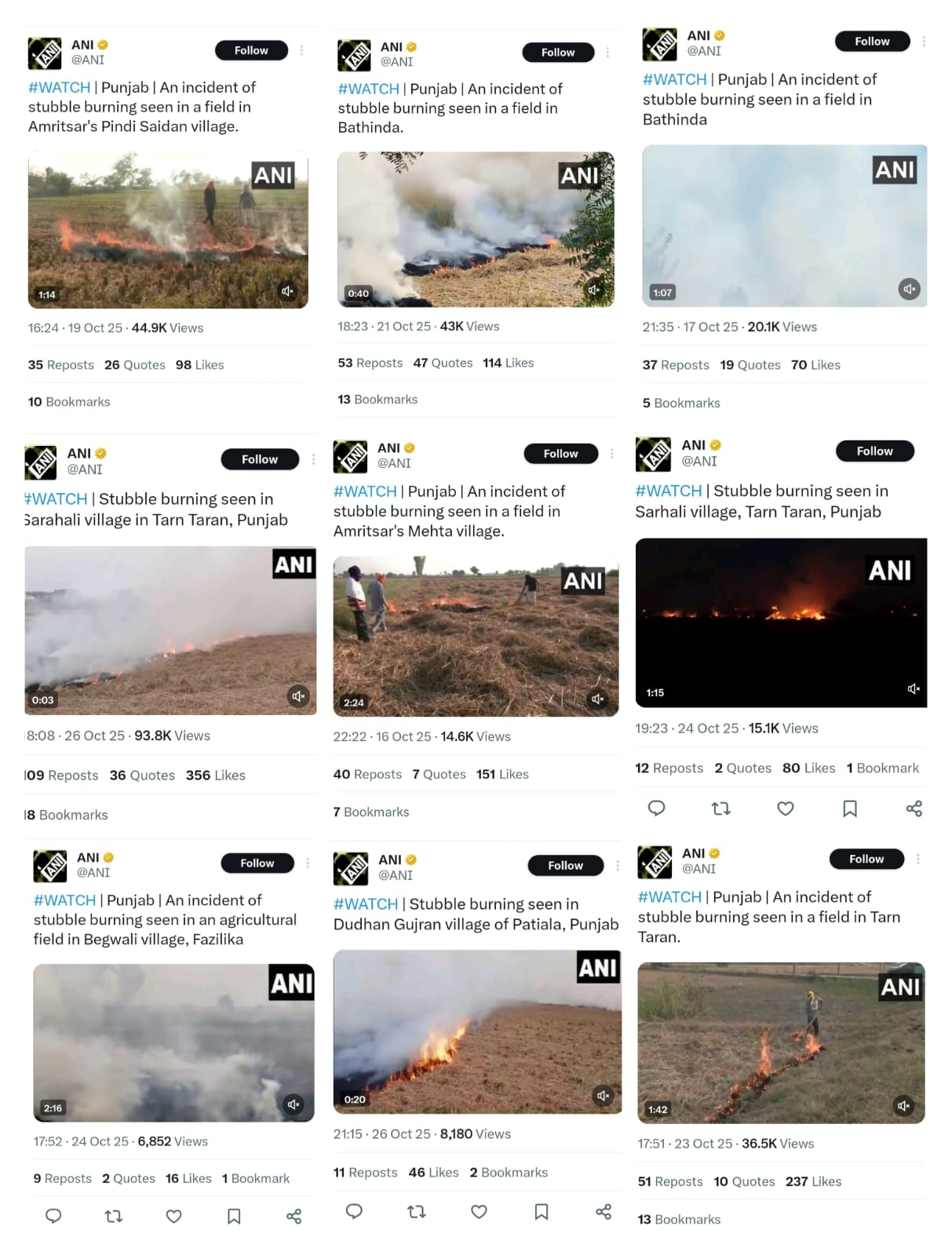
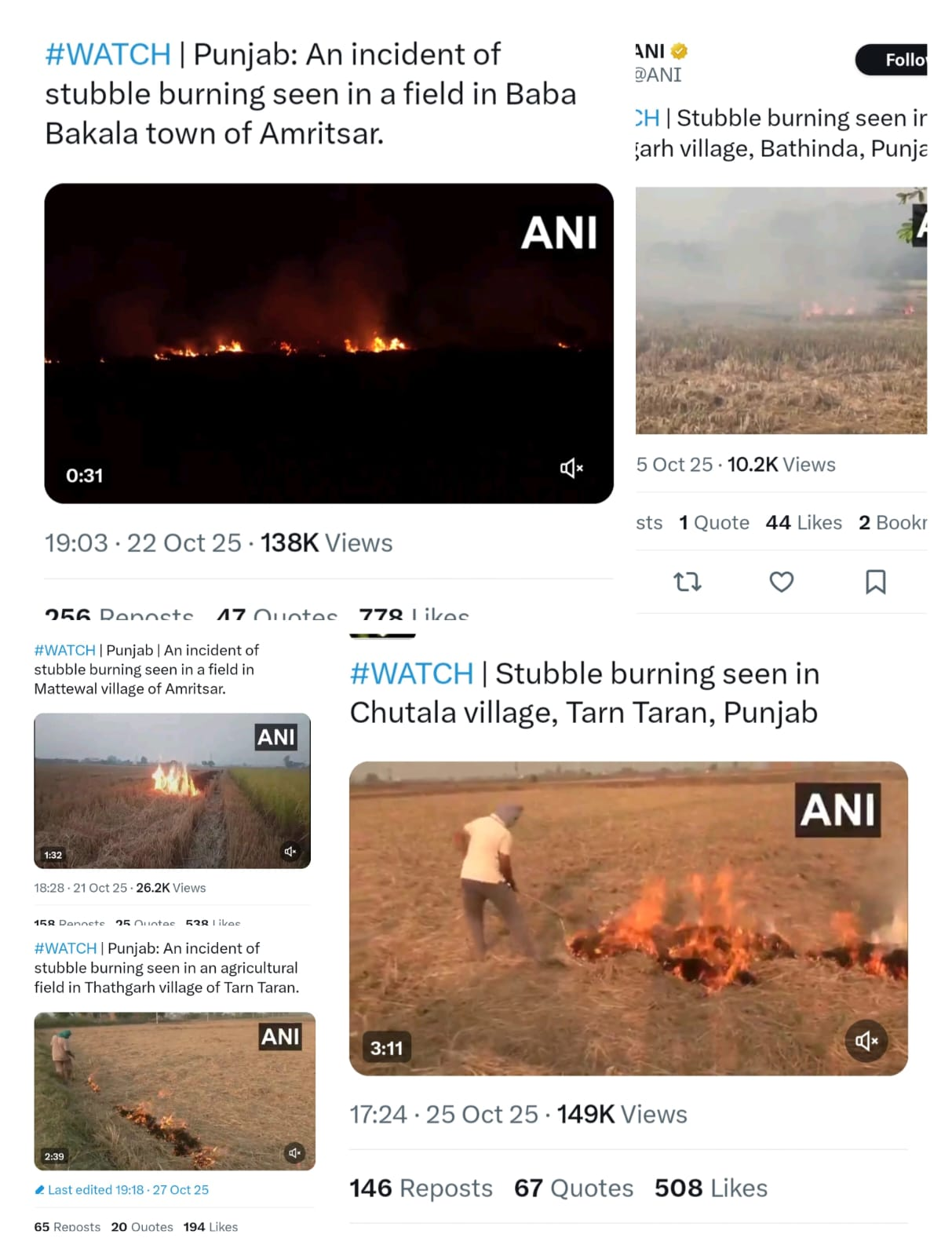
Scientific evidence clearly shows that Delhi’s smog stems from urban and industrial neglect, not from farming. Yet political and media narratives persistently scapegoat farmers, especially those from Punjab, allowing the real polluters to escape accountability.
What makes this even more unfortunate is the ongoing hate campaign against Punjab and its farmers. This is the same state that recently suffered its worst floods since 1988, devastating vast stretches of farmland. We compiled a few posts from X (formerly Twitter) to illustrate just how deeply this hate has seeped in, fueled by the relentless propaganda of figures like Amit Malviya and The Jaipur Dialogues.

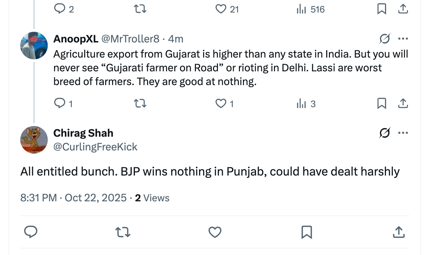
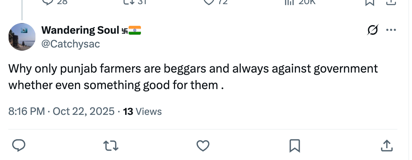
The ongoing vilification of Punjab and its farmers reveals a disturbing pattern of scapegoating and political propaganda. Despite clear scientific evidence showing that stubble burning contributes minimally to Delhi’s pollution, with Punjab recording only 415 farm fires this season, a 72% decline from last year, the state continues to be singled out, while industrial, vehicular, and urban sources remain largely unaddressed. Experts and farmer leaders have repeatedly stated that stubble burning contributes only 1–6% to Delhi’s air pollution, and strict monitoring and enforcement by the Punjab Pollution Control Board (PPCB) have further reduced incidents this year.
This narrative not only deflects accountability from systemic failures at the Centre and in the NCR but also fuels communal animosity against a state and a community that has historically resisted majoritarian agendas. Despite the reduction in farm fires and ongoing environmental efforts, political narratives and social media propaganda persist in blaming Punjab, while Delhi’s own industrial emissions, transport pollution, and post-Diwali firecracker use remain largely ignored.