Manufacturing hate against migrants
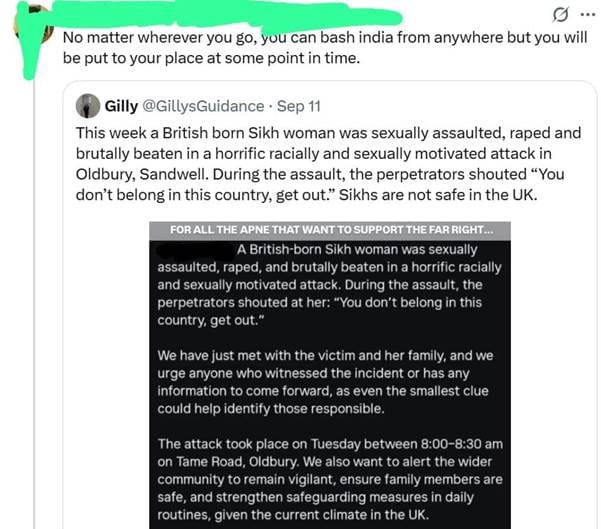
Last week, a young Sikh woman in her twenties was raped in Oldbury, West Midlands. During the assault, she was told to “go back to where she came from” - even though she was born and raised in the UK. I came across a tweet commenting on this case, and while I have hidden the name because the account is private, the statement was deeply unfortunate. It carried two troubling assumptions: first, that the victim must have “bashed India,” and second, that her “home country” is India. Such thinking is both dismissive and dangerous. It erases the lived reality of Sikhs who are born and rooted in Britain, and it also suggests that any criticism of India invalidates one’s right to speak against racism or white supremacy elsewhere. In my view, it is entirely possible - and necessary - to call out the dismal state of affairs in India while simultaneously condemning the violence and bigotry that Sikhs and other minorities face in the UK, USA, and beyond.
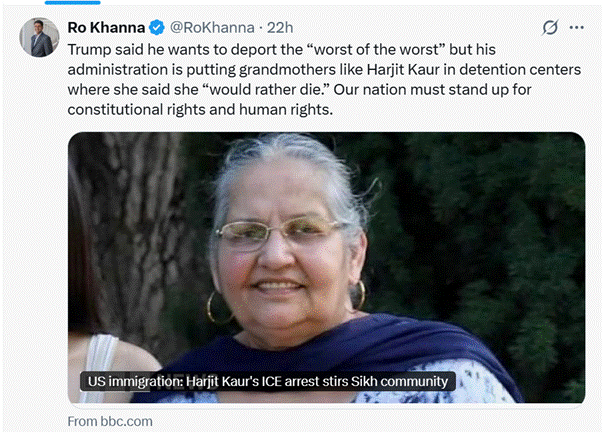
The Sikh community has faced such layered prejudices across borders. Recently in the U.S., 73-year-old grandmother Harjit Kaur, who has lived in California for more than three decades, was detained by ICE. Equality Labs, a Dalit civil rights organization, highlighted that she was the oldest in the detention facility, denied her medications, and her dietary restrictions were ignored. Her daughter-in-law told the BBC that Harjit Kaur said, “I would rather die than be in this facility. May God just take me now.” Despite having complied with six-monthly immigration check-ins since her final asylum appeal was denied in 2012, she was detained on September 8 in San Francisco under Trump’s broader immigration crackdown. While the administration vowed to deport the “worst of the worst,” critics note that it is often long-term residents without criminal records - people like Harjit Kaur - who are being targeted.
This broader climate of hostility was on stark display in London, where the rape of the Sikh woman did not deter 110,000 anti-immigration protesters from storming the city under the banner of the 'Unite the Kingdom' march, organized by far-right activist Tommy Robinson. According to Reuters, police admitted they were caught off guard by the scale of the rally, which was “too big to fit into Whitehall”, and reported facing “unacceptable violence” as they tried to contain the crowds. The march marked the culmination of a volatile summer of protests outside hotels housing migrants and carried a striking mix of symbols: Union Jacks and England’s St. George’s Cross dominated, but American and Israeli flags appeared alongside them. Many protesters even wore red 'Make America Great Again' hats, underscoring how far-right, anti-immigrant movements are increasingly interconnected across borders. Taken together - the racist assault in Oldbury and the surge of far-right street mobilizations in London - these events highlight the precarious position of minorities in Britain today, where acts of personal violence and mass political hostility are symptoms of the same exclusionary climate.
The chants were sharp and political, with Prime Minister Keir Starmer singled out as a target of anger. Placards bearing messages such as “send them home” revealed the anti-immigration sentiment driving much of the demonstration. Families also brought children, adding an unsettling juxtaposition to the heated slogans and nationalist imagery that defined the day.
This wave of hostility is not confined to marches or headlines; it seeps into everyday conversations. When I was staying at my aunt’s house, she justified the protests by saying, “they have kept asylum seekers in 5-star hotels.” This is exactly the kind of misinformation that has flooded platforms like TikTok and Facebook. One viral TikTok, for example, shows a speaker declaring: “Today’s the day that we learn it is costing us a billion pounds a month to house illegal immigrants—or shall we say put them up in luxurious hotels.” Similar claims have circulated widely on Facebook, with screenshots and posts framing asylum seekers as undeserving beneficiaries of 'luxury'. These narratives are not only misleading but dangerous, fuelling resentment and normalising the kind of violence seen in Oldbury and the vitriol on the streets of London. They construct migrants and minorities as burdens or intruders, setting the stage for both personal acts of hate and mass mobilisations of the far-right.
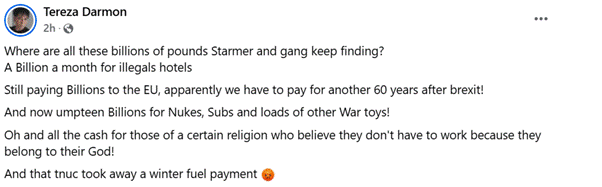
But the facts tell a very different story. According to a report by the National Audit Office, Britain spent £1.3 billion, about £108 million per month, on housing asylum seekers in hotels during the 2024–2025 financial year. This accounted for roughly three-quarters of the Interior Ministry’s £1.7 billion expenditure on asylum accommodation that year. As we can see, that figure is nowhere close to the exaggerated claim of “one billion pounds a month” circulating on TikTok and Facebook.
What I found most revealing was the contradiction in how people close to me responded. Both my aunt and uncle expressed sympathy for the Sikh woman who was raped, yet in the same breath, they justified the far-right protests by insisting that “unbridled migration leads to this.” But the truth is that migration to the UK is far from unbridled. As of January 1, 2025, there were only 38,000 asylum seekers, around a third of the total number the government accommodates, spread across 222 hotels. When placed against the scale of the UK population and economy, this is a controlled, manageable number.
Moreover, the contributions of migrants to Britain are consistently overlooked in these debates. A 2023 CEBR report found that migration brings in £3.3 billion to the UK’s public finances each month. Migrants pay taxes, bring diverse skills, and set up businesses that generate employment and growth. The economic reality is that migrants give far more than they take, yet the narrative pushed by far-right movements, and often repeated uncritically in everyday conversations, frames them as a drain. This gap between perception and fact is where prejudice takes root, where people can feel bad for a victim of racial violence, yet still rationalise the climate of hostility that enables such violence to occur.
Coming back to my very Punjabi, very Hindu relatives in the UK, I find that their political views are often shaped less by lived reality and more by the steady diet of TikTok clips and right-wing YouTube channels they consume. At the dinner table, conversations swing wildly from “India is the greatest country in the world” to “Khalistanis are a menace as they vandalise temples.” The latter claim has been debunked multiple times, yet it continues to circulate as fact within these circles. For example, when the temple in Brisbane was vandalised on 3 March 2023, and Khalistanis were immediately blamed, an investigation by Australian police later revealed that Khalistani elements were not involved at all. Instead, the act was carried out by individuals from within the Hindu community itself, as reported by journalist IP Singh here.
This pattern of scapegoating fits into the same ecosystem of misinformation that fuels anti-immigration protests and justifies racist violence. Whether it is far-right agitators in Britain exaggerating the costs of asylum seekers, or my relatives repeating baseless claims about 'Khalistanis', the underlying logic is the same: project social anxieties and political grievances onto minorities, even when the facts point elsewhere. It is in these contradictions, where sympathy for victims coexists with endorsement of hostility, and where unverified rumours are treated as truth, that prejudice finds fertile ground.
This raises a crucial question: where does migrant hate begin, and where does it end? Does it target only 'illegal' migrants? If so, why is Harjit Kaur, a 73-year-old grandmother who has lived legally in the United States for over three decades, detained by ICE despite following every requirement of the legal system? Does it end with 'Khalistanis'? If so, why do anti-India protests in countries like Australia target Indians broadly, including Hindus, students, and white-collar workers, rather than only specific activists? Does it stop at Muslims? If so, why was a Sikh woman born and raised in the United Kingdom raped in what was explicitly a racialized attack? These examples show that hostility is not confined to one group; it is a broader mechanism of exclusion that targets anyone deemed 'other', regardless of legality, history, or contribution to society.
Consider the case of Paramjit Singh, a green card holder who has lived in the United States for more than 30 years. He built a business in Fort Wayne, raised a family, and followed the law, yet ICE and DHS are imprisoning him over a 25-year-old infraction, using a payphone without paying 35 cents. On July 30, he was seized at O’Hare Airport and held incommunicado for five days, during which his brain tumour and heart condition spiralled into crisis, and his family only discovered his whereabouts when a hospital bill arrived. Months later, he remains locked inside Boone County Jail in Kentucky. His attorney has described his detention as “illegal and unethical,” but that is far too mild. This is barbarism, an act of state cruelty that strips a gravely ill man of dignity and care, weaponising a forgotten misdemeanour to torment someone who has given decades of his life to the country. ICE and DHS are not protecting America; they are persecuting a lawful resident and gambling with his life.
From the United Kingdom to the United States, from anti-immigrant marches to misinformation about 'Khalistanis', these stories reveal the same truth: prejudice thrives where fear and misinformation are allowed to dictate perception. It is not a matter of 'illegal' or 'foreign' versus 'law-abiding' or 'native'; it is about a system that targets anyone cast as different, undermining justice and human dignity in the process. Recognising this pattern is the first step toward accountability, empathy, and the protection of every individual, regardless of nationality, religion, or ethnicity.
Another example highlights just how far this hostility can go: a woman armed with three knives threatened to kill migrants at a hotel after consuming far-right content online, a court heard. The hotel was not housing any migrants, yet she told police, “I’m pissed off and I’m going to f***cking kill someone.” Her lawyer, Anjam Arif, a name clearly of migrant origin, meaning he or his parents or grandparents came from abroad, was defending her, underscoring the tragic irony of the situation.
My relatives here, who themselves came to this country as migrants, have been brainwashed into hating other migrants thinking that this would not cause them any trouble, but in these times we need to stick with each other. Stay informed, stay empathetic, and take care.